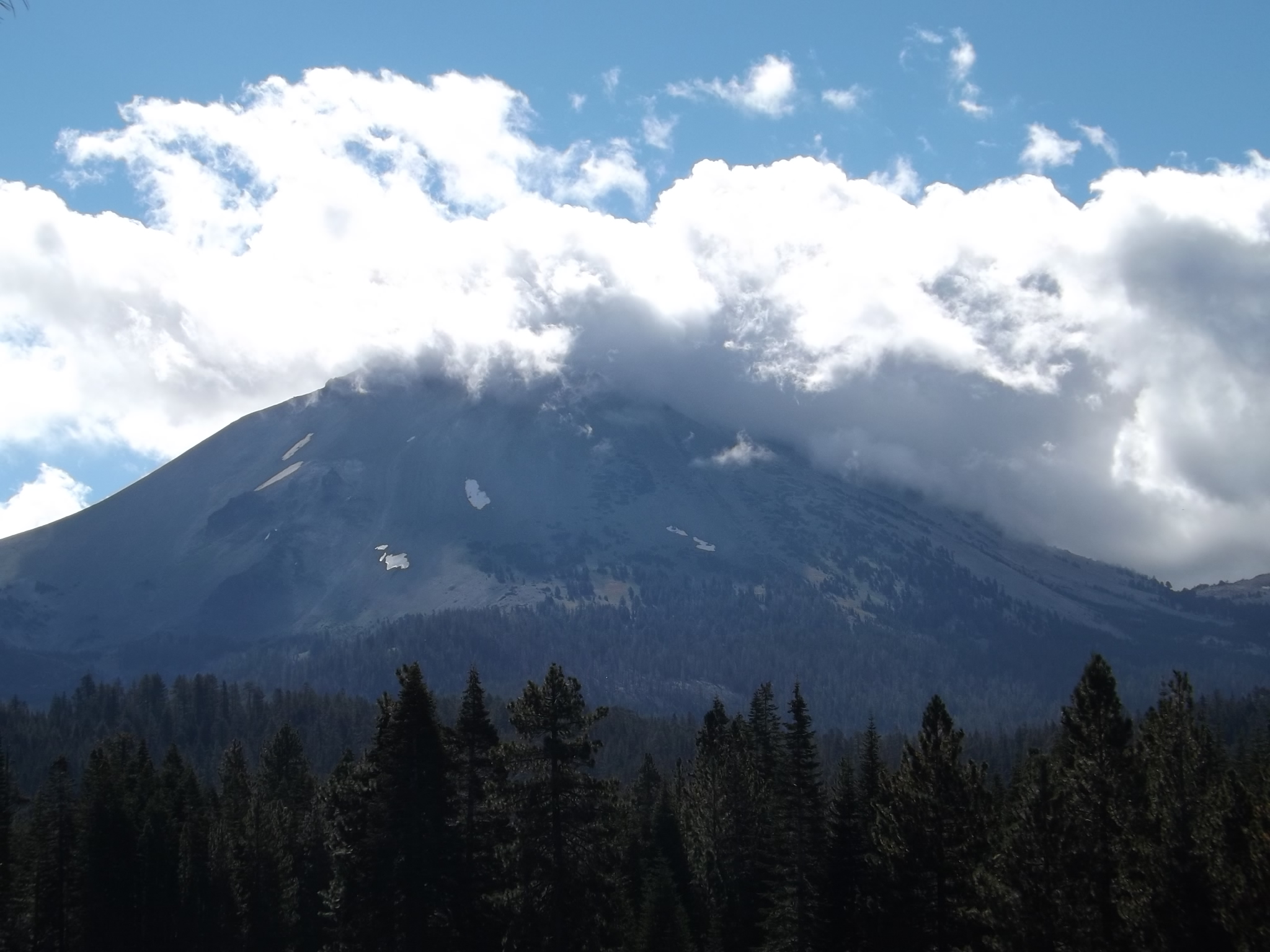
It’s finally time to talk about my favorite place on this earth – Mt. Lassen. I can’t remember ever not loving the park that surrounds the volcanic area, and have been camping there every summer since I was an infant. This is where it all began: where my love for geology, volcanoes, science, and star-gazing started. But it goes back farther than that; this place is in my blood. Before me, my sister, and my mom came along, my dad was camping at Lassen, going regularly since high school. As a young boy, my grandparents took him and my uncle for an overnight visit at Kings Creek, a fertile and lush creek bed in the valley at the foot of Mt. Lassen. This was the very first Leone pilgrimage to the volcano, and because the park was relatively unknown, it was not nearly as developed as it is today. Needless to say this initial trip was the last for my grandparents and, according to my dad, was not the ideal trip for my grandmother especially.
Though my grandparents never made it back, my dad has taken us every year, and I find myself looking forward to the trip all year round. I simply can’t say in one blog post how beautiful the land is; there’s too much to see and learn to experience everything in one visit. My advice: go, every year, several times a year. It won’t matter, because you’ll be as in love with it as I am.
The park itself encompasses more than just Mt. Lassen, and there are many other smaller, extinct volcanoes peppering the area. From the peak of Mt. Lassen you can see many of them, and in the area outside directly outside the park. Lassen itself is a dome formed from the northeastern arm of the extinct and destroyed Mt. Tehama, a stratovolcano that was active about 600,00 years ago, and finally caved in on itself forming a caldera (a large basin at the summit of a volcano forming from its collapse), which you can easily see from places like Bumpass Hell (that will be its own blog, so stay tuned).
Mt. Lassen is the southernmost volcano of the Cascade Range (going from northern California all the way up to British Columbia). This particular volcanic mountain range formed from the Juan de Fuca and Gorda Tectonic Plates subducting beneath the North American Plate. For those of you unfamiliar with volcanic processes, when two plates collide, one of several things can happen. In one scenario, one plate is pushed below another (in this case the subducted plate is oceanic and more dense because of its basaltic composition), the subducted rock moves through the crust and upper mantle, melts, and is pushed back up to the surface, and, in the case of the Cascades, forms a volcano.
Mt. Lassen started forming about 27,000 years ago, and reached a height of activity from 1914-1917. Over the course of those three years, all the volcanic activity shaped the dome and landscape into what is seen today. Most of the devestated areas directly below the volcano have naturally restored themselves, but some areas, like Chaos Crags, clearly show the extensive lava flows resulting from the years of violent eruptions.
Today, Lassen is one of the world’s largest dome volcanoes, standing at roughly 2,000 feet. Many of you may be wondering if Mt. Lassen is still active, given its last eruption was over one hundred years ago. Even without lava-producing eruptions, Mt. Lassen is still considered an active volcano. Fumaroles, hot springs, and mud pots can be found all over the park, and are a sign of heat and activity below the surface. Boiling-hot water is characteristic of these geological features, and in order for the ground water to be hot enough to steam at the surface, a strong heat source must be present, that heat source being the live, albeit dormant volcano.
But don’t let this deter you from going to see it. The fumaroles and mud pots alone are beautiful, unusual, and fascinating specimens. If you can get past the strong sulfur odor (especially potent after a wet season), it’s hard not to see the beauty and delicacy of them. There is, of course, so much more to the area than volcanoes and volcanic activity (although that’s a large reason why I’m attracted). It’s a place where anyone who appreciates organic beauty can stand in wonder. It’s the sort of thing that makes you feel small and peaceful, being surrounded by so much that is older and grander than yourself.
Now go off, my lovely readers, and explore and wonder and wonder and wonder.


Other than the spectacular ancient landforms in Ireland, I can’t think of a more interesting place to visit. Reading this segment reminds me of how awed I was the first time I camped in the park. Climbing Lassen the first (and last time….yikes!!) time made me appreciate what a force of nature a volcano can be. Hey, how about Mt. Saint Helens?
LikeLike
Don’t worry, Mt. Saint Helens is coming sooner than you think. Before the end of the week there will be a post on it 🙂
LikeLike