In 1968 a tiny volcanic island off the coast of Iceland formed seemingly overnight. Scientists watched as each day the underwater volcano spewed enough magma to form an island. Hot magma meeting the cold sea water contributed to its formation, as it allowed the lava to cool quickly enough, while more magma was rising, to build on itself. This tiny island became known as Surtsey.
This story is much like the events starting in 1968, except we’re now in Japan.
It’s not every day you have the opportunity to witness the birth of an island, or a volcano for that matter. Though not an unusual case, this is no less fascinating and exciting for the world of science.
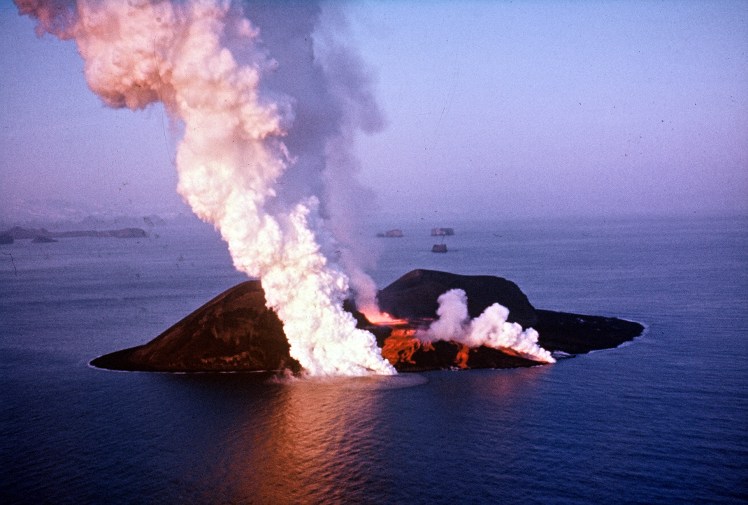
The volcanic events started as an eruption southeast of the Japanese island of Nishino-Shima in November of 2013. Since 2013 there have been two distinct stages in the creation of this island. Early aerial views showed formations of the island having a’a-like lava flows (a’a is the sharp, jagged lava, usually more gaseous and volatile), and eventually giving way to smoother lava flows later on. This first stage, in which hot magma meets cold sea water to form the foundation of the island, is known as a surtseyan eruption (hence the introduction about the island from which this stage is named). Pictured below is the island of Surtsey, not unsimilar in nature to its Japanese cousin.
Within the first month the new island rose 25 meters (or 82 feet) above sea level – that’s about equivalent to an 8-story building. By the end of the year, however, lava flows started to move out rather than up from the mouth of the volcano, causing the new island and Nishino-Shima to form as one.
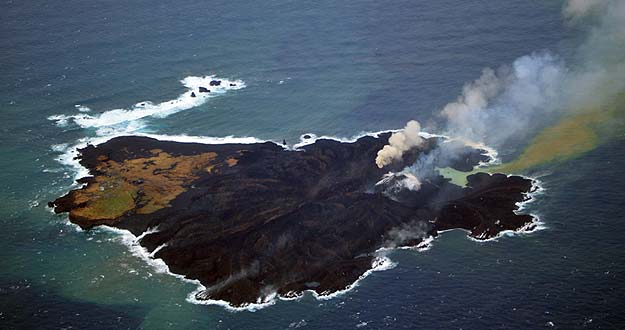
The second stage, known as a strombilian eruption, is characterized by “fountains” of fire building on cooler lava beds, and marks the distinct characteristic change in eruptions once the lava broke the water’s surface. After the initial eruptions, “dry” gas now came out of the mouth of the volcano (shown below). Also shown is an aerial shot of the two, nearly-conjoined islands


Since November 2013, Nijima has produced approximately 200,000 cubic meters of magma a day, the equivalent of 80 olympic swimming pools. You may be wondering at this point if the island is habitable, if it can support life even in the early stages of its formation. Here’s where volcanism and biology meet; volcanologists are excited for obvious reasons, but biologists are waiting to see if life can in fact survive and thrive, and what wildlife will inhabit the island first. As of now, only sea birds have helped fertilize the island (feces containing undigested seeds, etc). The real question that remains is whether or not the active volcano will continue to produce enough magma to withstand weathering from rain, wind, and seawater.
Rejoice in the fact that you are witnessing history. As they say, big things come in small packages. The formation of this island shows the origins not only of similar islands and volcanoes, but of new ecosystems.
Adventure on my beloved readers!
 Volcanism