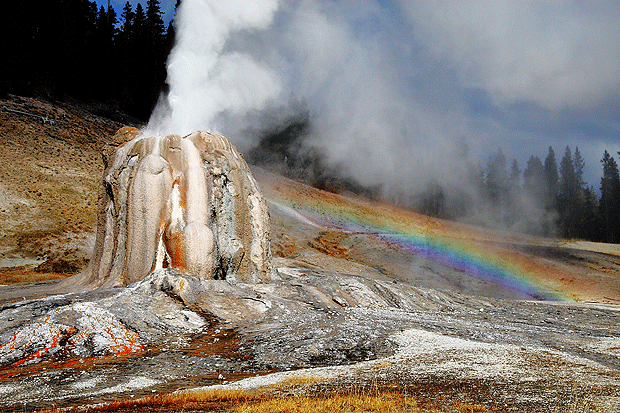
Yellowstone is one of the many places where the more research I do about it, the more anxious I am to see it in person. A professor of biological sciences at the university I worked at recently did some amazing research at Yellowstone on extremophile bacteria (that is, bacteria that can survive in extreme conditions that would otherwise be uninhabitable). Her trip motivated me to finally write about the park.
The Yellowstone Plateau volcanic field produced two of the largest and most catastrophic eruptions in earth’s history. The caldera that exists today was formed approximately 640,000 years ago after an eruption of more than 1,000 cubic kilometers of ryolitic magma resulted in the collapse of the central area (if you’re a little fuzzy on the creation of calderas, refer to the post about Crater Lake for a refresher course). There are two types of lava flows can be found in the park: 1) ryolitic magma in the central area, which is consistent with seismic velocity recorded and with a shallow seismic zone underneath the caldera; and 2) basaltic lava flows along the Plateau margins – that is, along the edges of the collapsed volcanic area.
Before I continue, it is important to note that supervolcanoes rarely have more than a couple supereruptions in their lifetime, so if you ever thought Yellowstone would bring on the next apocalypse, let me assure you it won’t.
The monitoring of volcanic activity and the likelihood of another similar event, however, can be especially difficult with large calderas such as Yellowstone Plateau. In this case, the flux of heat and volatiles (dissolved gases) are measured to assess volcanic activity.
Why is the fluctuation of heat and dissolved gases so important, you may ask? Simply because the presence of heat and volatiles indicates the presence of a heat source – in this case, magma. So long as there are geysers, mudpots, fumaroles, and hot springs, there is volcanic activity and a heat source to sustain these volcanic features. At the same time these same features are thought to help ease the volcanic pressure that would result in a much larger and catastrophic eruption.
There are other factors to consider when discussing the possible eruptive scenarios at Yellowstone. The last 50 eruptions were simple lava flows, which is a good sign for future activity. And of past supereruptions, none of them resulted in mass extinctions.
There has been talk of Yellowstone “rising” – meaning the ground around it rises due to rising underground magma, which occurs just before an eruption. Records of Yellowstone show rising and subsiding fairly regularly without an eruption following. In 2015, however, there has been no signs of ground rising.
What does this mean, then? This simply means common misconceptions about Yellowstone don’t take all things into consideration when discussing the possibility of another catastrophic event. Have no fear – I am here to help inform and inspire you!
So go out and adventure with a greater appreciation for the amazing features of Yellowstone National Park.

 Volcanism