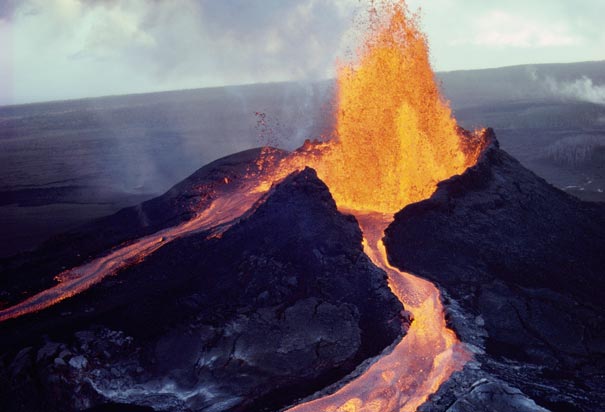
Hawai’i is no stranger to volcanic activity. In terms of tourism, I’m not the biggest fan. But when it comes to volcanism and studying volcanic activity, the Hawai’ian islands are some of the most fascinating places on Earth.
The islands, if you’ll notice on a map, form a sort of chain, starting in a north-western corner of the Pacific, and trailing south-east. Curious, isn’t it? That’s because the islands of Hawai’i sit directly on top of a hot spot – which is a plume of magma that comes up inside of a techtonic plate instead of along its edges (there was a short mention of it in the previous post). The plume itself is stationary, but you can track the movement of the actual plate by following the trail of islands produced as a result of the regular volcanic activity. All the magma that comes up from this plume accumulates to eventually form an island from the volcano (or several volcanoes, depending).
In short, the Hawai’ian islands are all volcanoes. Imagine living on an island, except that island is really a volcano. It’s a frightening and oddly fascinating idea, for those of you who are in to that.
A few things must be understood about this particular volcano, before we get deeper into this story. Kilauea has been erupting almost non-stop since 1983 (that’s 31 years for those of you who don’t want to do the math), and this particular lava “creep” featured in the news this past weekend has been threatening nearby towns since June. The lava itself, if you watch videos, is dark and glossy, very characteristic of basaltic (mafic) lava flows, as I’ve been mentioning over the past few posts. Also, it moves relatively quickly; this particular flow moves at about a foot a minute. Not only is that fast, but it can be extremely dangerous and destructive for towns built close to the volcano.
Another important feature regarding the lava is the consistency and texture as it cools. There are three types of mafic magmas: pahoehoe, aa, and pillow (which will be discussed in a later post, as it doesn’t apply to this story). Pahoehoe is the long, ropy, smooth lava you often see, whereas aa is rocky, jagged, and sharp-edged; pillow basalt is just that: as it flows and cools it billows and forms rounded, pillow-like mounds.
In terms of the Kilauea situation of this weekend, video clips show a smooth, fast-moving lava flow. As I mentioned earlier, this could be extremely dangerous and destructive. As of Sunday, the lava flow is about 700 meters from Pahoa (although it has already destroyed the town’s cemetary), and is expected to reach the town by tomorrow. Before Sunday most residents had already evacuated, with Hawai’i’s Civil Defense Agency going door-to-door yesterday to let those remaining know of a possible evacuation should the situation become worse.
This should not scare you, however, from visiting volcanoes (or Hawai’i for that matter), because these eruptions teach geologists a lot about volcanoes: not only in how they work, but in what preventative and evacuation measures can be taken so that humans and volcanoes don’t have to have a completely disastrous relationship. Kilauea has been erupting for over 30 years, and in that time there has been only one death. This says nothing, however, to the homes and land destroyed, but the odds so far don’t look so bleak as one may think.
This simply reminds us of how little control over the land we have, that natural forces will eventually let their power and presence be known, and all we can do is step aside and let Mother Nature do her thing.
Let there be no love lost here, my dear readers. Continue to adventure.
 Volcanism
Wow…talk about the force of Mother Nature. I would love to be able to witness this frightening event. Love the horror flicks about volcanos, but this takes it to another level. Last I heard, the lava flow has reached homes. As awesome as this event is, I feel for the families that have lost their homes.
What’s next?
LikeLike